Choosing well before you pay: finds, sellers, agents and lists
Five short checks, from the list you browse to the parcel you will receive, each tied to a rule Hipobuy publishes.
Read and checked 10 November 2026
Holding a finds list to account, starting here
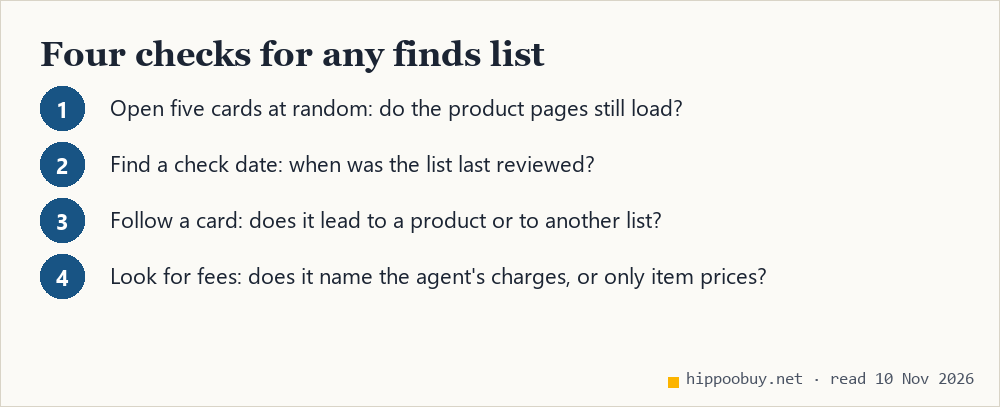
A finds list is only as good as its upkeep. Before you trust one, open five cards at random and see whether they still lead to a live product page. Look for a date somewhere on the site that tells you when it was last checked. Check whether the list sends you to products or only to more lists. And notice whether it tells you what the agent charges, or only how cheap the items look.
What makes a useful spreadsheet, then, is mostly dull: links that work, shelves that match what is on them, dates on anything that changes, and no pretence that the list itself sells you something. Hold this site to the same test. Its pages carry the day each fact was read, and the outbound links were tested on 10 November 2026; if you find a dead one, the about page has an address for telling us.
Sellers: reading the signals on a listing
How to judge a seller starts on the listing page, before you paste anything into Hipobuy. On Taobao, the store’s age and its rating badges show how long it has traded; on Weidian, which is a storefront tool rather than a marketplace, there may be no ratings at all, so the shop’s own photos and its reply to questions count for more. On 1688, many sellers are factories or wholesalers with minimum order quantities, which Hipobuy’s product page shows next to the quantity box.
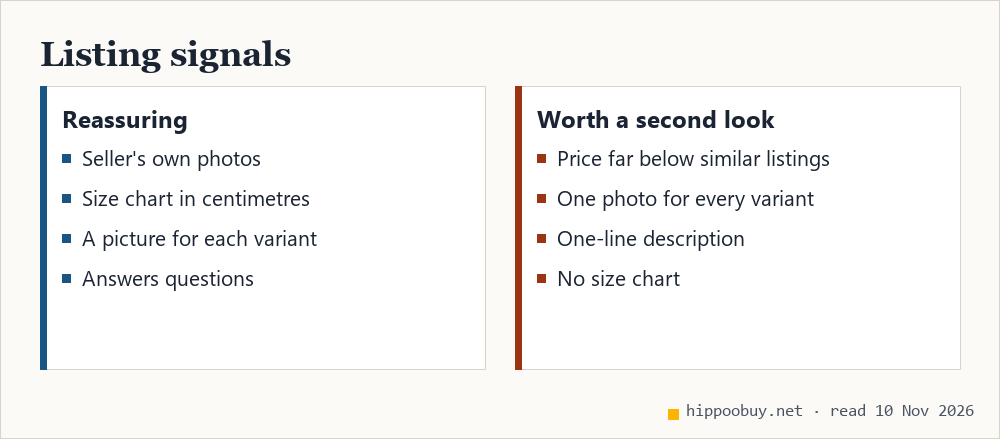
Good sellers tend to show their own photos rather than catalogue shots, give a size chart in centimetres, and list each variant with its own picture. Be wary of a listing whose price is far below every similar one, whose variants share one photo, or whose description is a single line. When in doubt, use the Leave a message box on Hipobuy’s order screen to ask the buyer to confirm a detail with the seller before paying.
Agents: what to read before trusting one
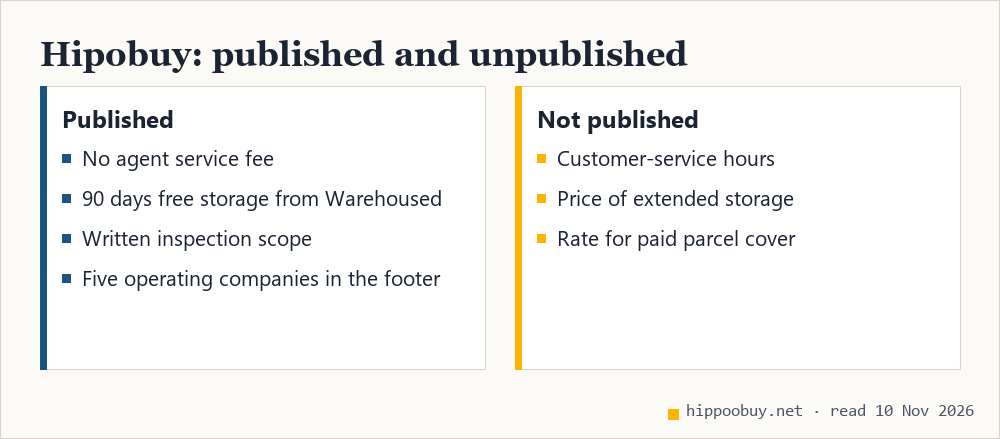
Picking an agent comes down to reading. An agent worth trusting puts its fees in a help article you can link to, says how long it stores goods free and from which status the clock starts, explains what its inspection covers and what it does not, and names the companies that operate it. Hipobuy does all four: no agent fee, 90 days from Warehoused, a written inspection scope, and five operating companies in its footer.
Then check the gaps. Customer-service hours, the cost of extra storage days and the rate for paid parcel cover are all missing from Hipobuy’s pages. None of that is unusual, but it tells you what to ask before it matters. The same reading applies to any agent you compare it with; the other agents page sets three of them side by side from their own pages.
Items: deciding what to order
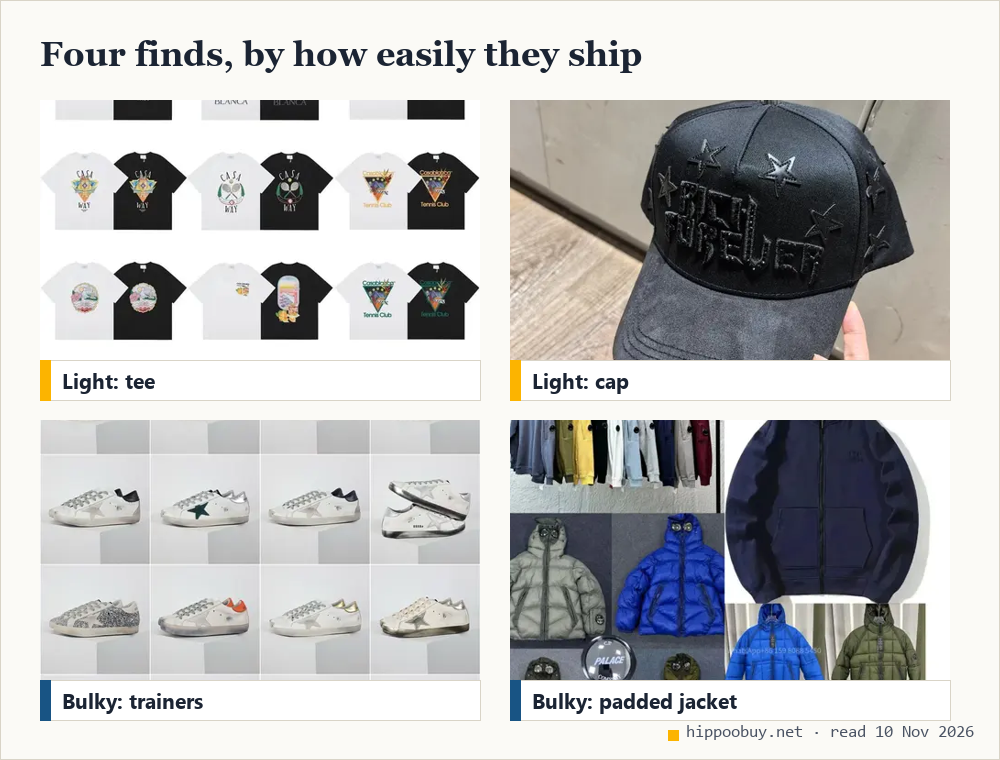
Deciding what to order is easier when you start from the parcel backwards. Light, compact goods such as tees, caps and belts ship cheaply on almost any line. Bulky coats and boxed trainers are where volumetric weight bites. Liquids, batteries and anything magnetic narrow the lines that will accept your parcel, and some goods cannot be shipped at all.
For clothing, measure a garment you already own and compare it with the seller’s chart, not with a letter size. For shoes, check the insole length in centimetres. For anything with moving parts, remember that Hipobuy’s warehouse does not test function. If an item only makes sense at a certain size or colour, say so in your remark so the buyer can stop and ask rather than order the wrong thing.
Last checks before paying
Run through these before you pay for anything.
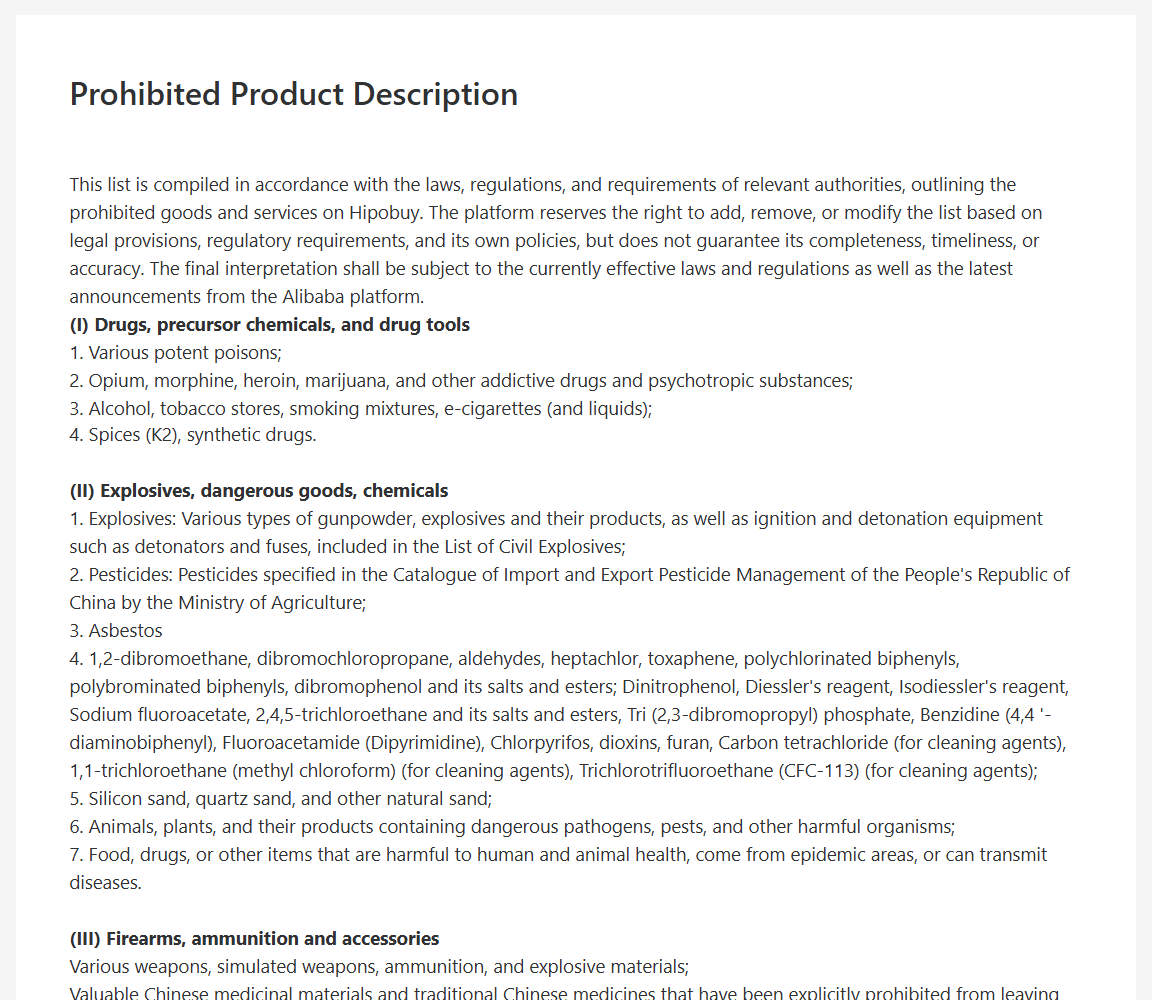
- Prohibited goods. Hipobuy’s prohibited products list covers drugs, e-cigarettes and their liquids, weapons, explosives and chemicals, counterfeit and pirated products, and supplements, vitamins and herbs, among others. Gold and silver items are on it too.
- Liquids and cosmetics. Limited to 100 ml per product and 200 ml per parcel, per Hipobuy’s estimator notes.
- Parcel size. Hipobuy warns that parcels over 10 kg are relatively likely to be treated as commercial by customs.
- The return clock. 120 hours from the hour after an item is Warehoused. Read QC photos the same day.
- The storage clock. 90 days from Warehoused, then disposal unless extended.
- Your own customs rules. A line labelled tax free is a property of the line; your country’s rules still apply. Check your national customs site before a large order.
- The address bar. hipobuy.com for every payment, whichever spelling you searched for.